
We explain what counts as commercial debt and the difference between refinancing versus new debt with RIC.
What you will learn:
- What is commercial debt
- Why commercial debt is required for a RIC loan
- What counts as commercial debt, and what doesn’t
- How RIC loans work for refinancing commercial debt or supporting new debt
- Why is it important to maintain a good relationship with your commercial lender
What is commercial debt
Commercial debt is a financial commitment to repay borrowings that has been established on commercial interest rates, terms and conditions. For example, a bank or other financial institution has taken formal security, and you hold a signed loan agreement, including mortgage or caveat documents.
Private and family loans may qualify as commercial debt if they are issued with a formal loan agreement, commercial interest rates, terms and conditions.
Why commercial debt is required for a RIC loan
To be eligible for a RIC loan, you must have commercial debt (or be on your way to being approved for commercial debt in the case of the AgriStarter Loan only)
RIC loans are designed to work alongside an existing commercial lender, not compete with them.
At least 50 per cent of your total debt must initially be with a commercial lender.
Your amount of commercial debt will determine how much you can borrow with RIC (subject to the borrowing limit for each loan) For example, if your current total commercial debt is $500K, you may be able to borrow up to $500K with RIC for a Drought Loan, Farm Investment Loan and AgriStarter Loan or AgBiz Drought Loan, subject to meeting all eligibility and assessment requirements.
See how this works in the figures below.
What counts as commercial debt, and what doesn’t
Commercial debt includes the following types of debt:
- Bank loans secured against farm assets Commercial lending facilities with formal loan agreements
- Some private or family loans, provided they are established on commercial terms and conditions and at commercial interest rates.
Commercial debt does not include any of the following types of debt:
- Home loans, personal loans (for holidays, vehicles, medical expenses, home renovations, investment purposes etc.)
- Private or family debt that has not been provided at arm’s length, at commercial rates, with terms and conditions
- Non balance sheet loans
- Funding of normal or additional working capital
- Debt at concessional interest rates established under government schemes (Australian Government, state or territory)
- Equipment finance facilities (Please note: Equipment finance facilities are accepted as eligible forms of commercial debt only for RIC’s Marine Recovery Loan and the AgBiz Drought Loan)
How RIC loans work for refinancing commercial debt versus taking on new debt
RIC loans can be used for:
- refinancing (restructuring existing debt)
- accessing new debt for operating expenses and capital expenditure.
Either way, after you have a RIC loan, at least 50 per cent of your total debt must still be commercial debt. So, the total amount of your RIC loan cannot be more than the amount of your commercial debt.
The maximum borrowing amount for each RIC farm business loan including AgriStarter, Drought and Farm Investment is $2 million. The maximum amount you can borrow for the AgBiz Drought Loan is $500,000. Borrowers can have more than one RIC loan however, the total amount borrowed for RIC loans cannot exceed $2 million. Borrowers must not hold more than $3 million in Commonwealth and State-based concessional loan programs.
Figure 1 shows two scenarios for a farm business applying for a RIC Drought Loan with $800,000 in existing commercial debt.
- If they use their RIC loan to refinance, the maximum amount of the RIC loan is $400,000.
- If they use their RIC loan to access new debt, the maximum amount of the RIC loan is $800,000.
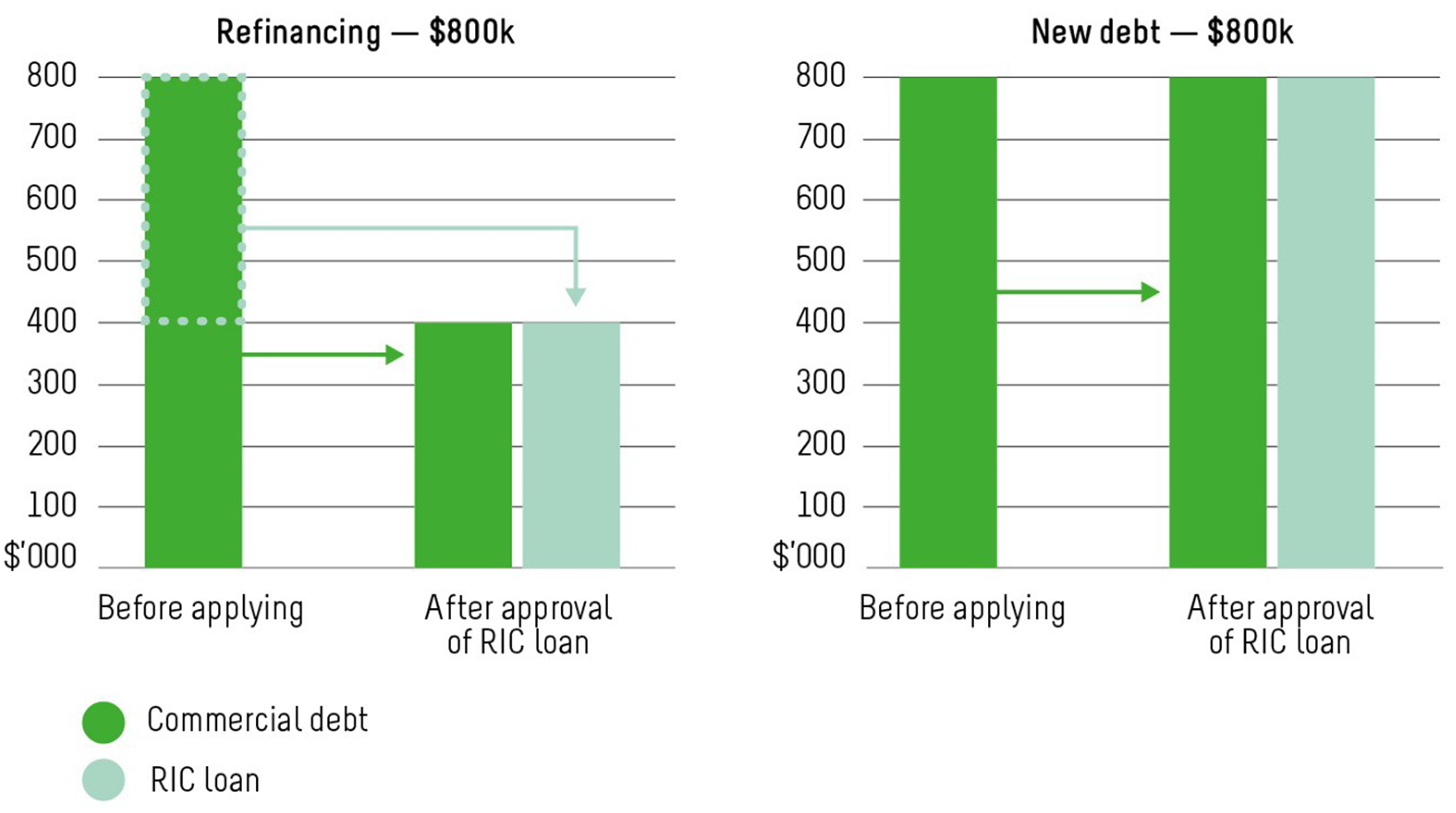
Figure 2 shows two scenarios for a farm business applying for a RIC Drought Loan with $2.4 million in existing commercial debt.
- If they use their RIC loan to refinance, the maximum amount of the RIC loan is $1.2 million.
- If they use their RIC loan to access new debt, the maximum amount of the RIC loan is $2 million.
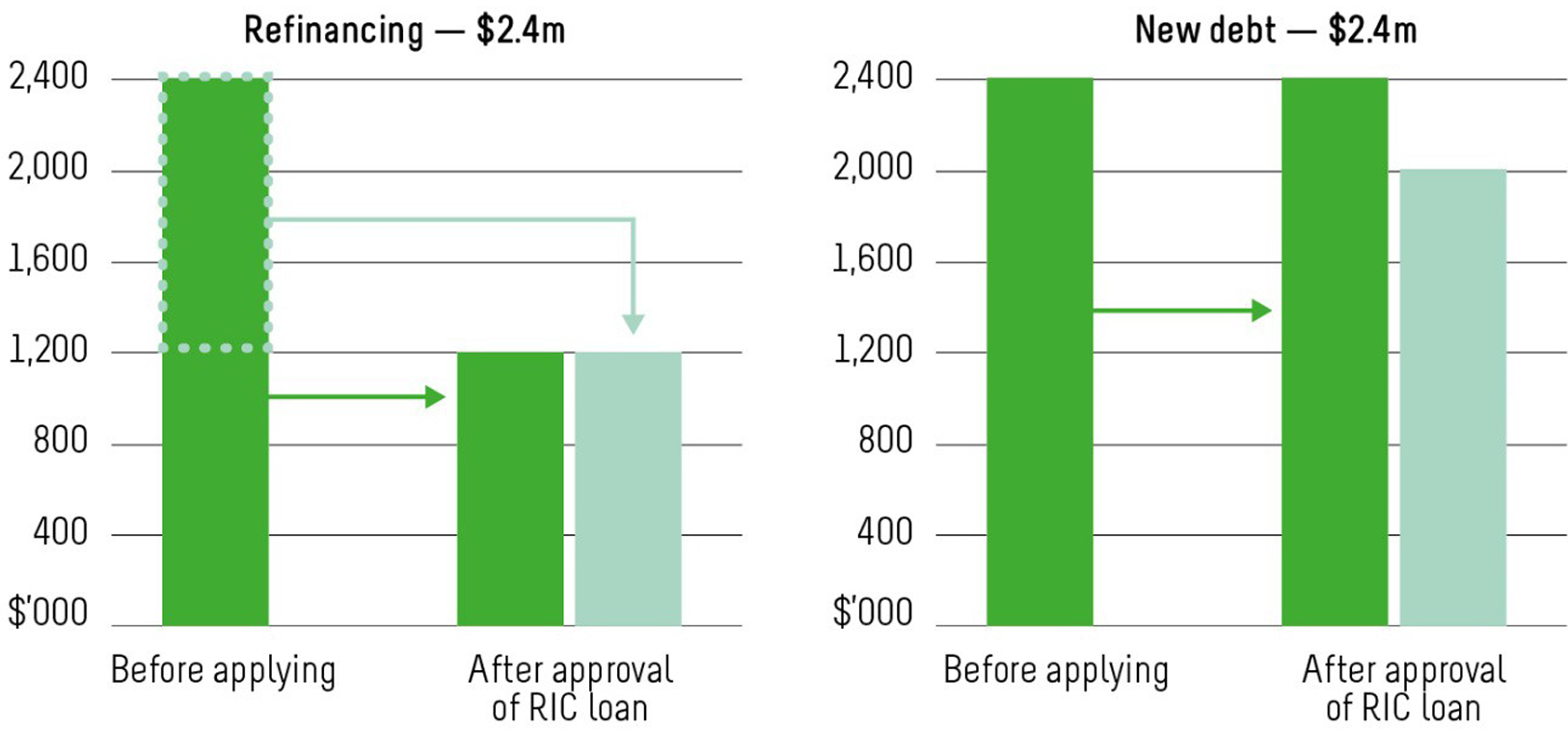
Note: Under a new debt of $2.4 million, the loan amount does not match the amount held in commercial debt because the maximum amount of a loan is capped at $2 million.
Why it’s important to maintain a good relationship with your commercial lender
RIC loans are designed to work alongside an existing commercial lender. At the end of the RIC loan term, or whenever is appropriate for your business, you seek to refinance back to your commercial lender in a stronger financial position than before your RIC loan.
RIC is there to support you in that time of hardship. When you have returned to your normal operating capacity, maintaining a positive relationship with your commercial lender can help make the transition smoother, particularly if you need to refinance your RIC loan.
If you have questions about commercial debt, contact us.